
Prevalence of Long Covid
Post-COVID Condition / Long COVID
Best estimates across population studies suggest:
- ~10–30% of people infected with SARS-CoV-2 experience persistent symptoms beyond the acute phase
- This places tens of millions globally under the Long COVID umbrella.
Public health bodies and research programs (including National Institutes of Health RECOVER) treat this as a mass-disabling condition.
How many of these are “spike-mediated”?
This is unknown—and exactly why measurement matters.
Current evidence suggests:
Some subset of people with PASC show circulating or tissue-associated viral antigens, including spike
Not all people with PASC do
Not all studies agree on pathogenic significance
Translation: spikeopathy is likely a phenotype or sub-phenotype, not the entirety of Long COVID.
The Pathophysiology of Spikeopathy
1) Viral Antigen Persistence (Central Hypothesis)
Multiple peer-reviewed studies have reported:
Detectable SARS-CoV-2 antigens (including spike or S1) months after infection in subsets of patients
Evidence of viral persistence in tissues (GI tract, brain, etc.) in some autopsy and biopsy studies
Persistent antigen → chronic immune stimulation
Chronic stimulation → inflammation, endothelial injury, autoimmunity, autonomic dysfunction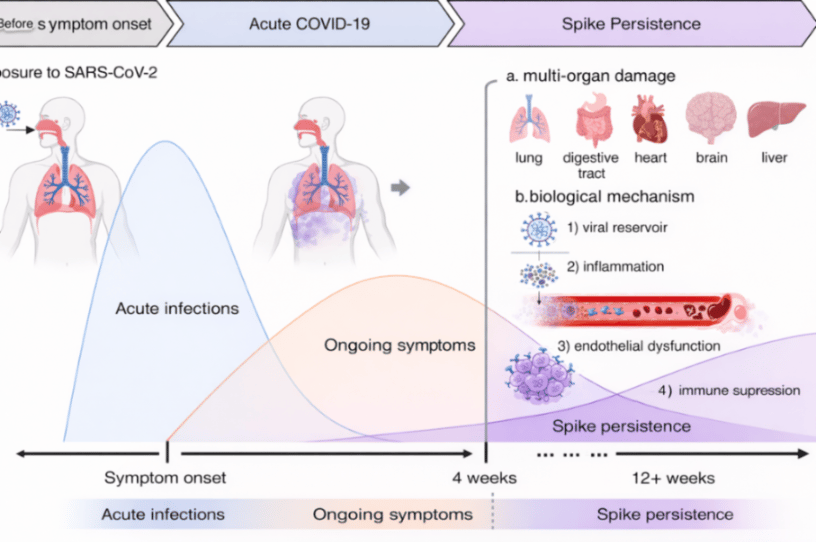
2) Endothelial Dysfunction & Vascular Injury
Spike protein has been shown in vitro and in vivo to:
Interact with ACE2-expressing endothelial cells
Promote endothelial activation/dysfunction of the heart, vessels, and lymphatic system
Disrupt nitric oxide signaling and vascular tone
Downstream effects
-Impaired microcirculation
-Oxygen delivery problems
-Exercise and orthostatic intolerance
-Chest pain, headaches, brain fog, dysautonomia
.png?width=500&height=333&name=download%20(3).png)
3) Immune Dysregulation & Autoimmunity
Observed in subsets of patients:
Population shifts and depletion of T-cells
Persistent cytokine signaling
Autoantibodies and chronic immune system irritation
.webp?width=1036&height=622&name=download%20(1).webp)
4) Microclotting & Impaired Fibrinolysis
Some groups have described:
Fibrin amyloid microclots
Platelet hyperactivation
Impaired clot breakdown
Increased maternal hemorrhage and altered blood clotting cascades
.png?width=500&height=750&name=download%20(4).png)
5) Autonomic Nervous System Disruption (Dysautonomia)
Common clinical manifestations:
POTS-like symptoms
Orthostatic intolerance
Palpitations
Temperature dysregulation
Neuroinflammation
Spike-mediated immune effects are one possible contributor, not the sole cause.
.webp?width=500&height=749&name=download%20(2).webp)
Why the Field Is Stuck (and Why Measurement Is the Bottleneck)
Right now:
PASC is diagnosed clinically
Routine labs are often normal and standard therapeutics ineffective
Studies disagree because:
-different assays
-different timing
-different phenotypes lumped together
Without quantitative, reproducible measurement of relevant biomarkers (including spike antigen where appropriate):
-hypotheses remain unfalsified
-patient subgroups remain blurred
-therapeutics remain trial-and-error
Spikeopathy represents a working hypothesis that persistent or dysregulated spike-protein biology may contribute to illness in a subset of post-COVID patients through immune, endothelial, autonomic, and coagulation pathways. Determining its prevalence and relevance requires quantitative, longitudinal measurement.
Scientific controversy collapses into a single question:
Who has measurable spike antigen, when, at what levels, and how does that correlate with outcomes?
That question cannot be answered by:
PCR
antibody titers
symptom checklists alone
Click below to learn more about spikeopathy research and Post Covid Conditions
Proceed to page below: